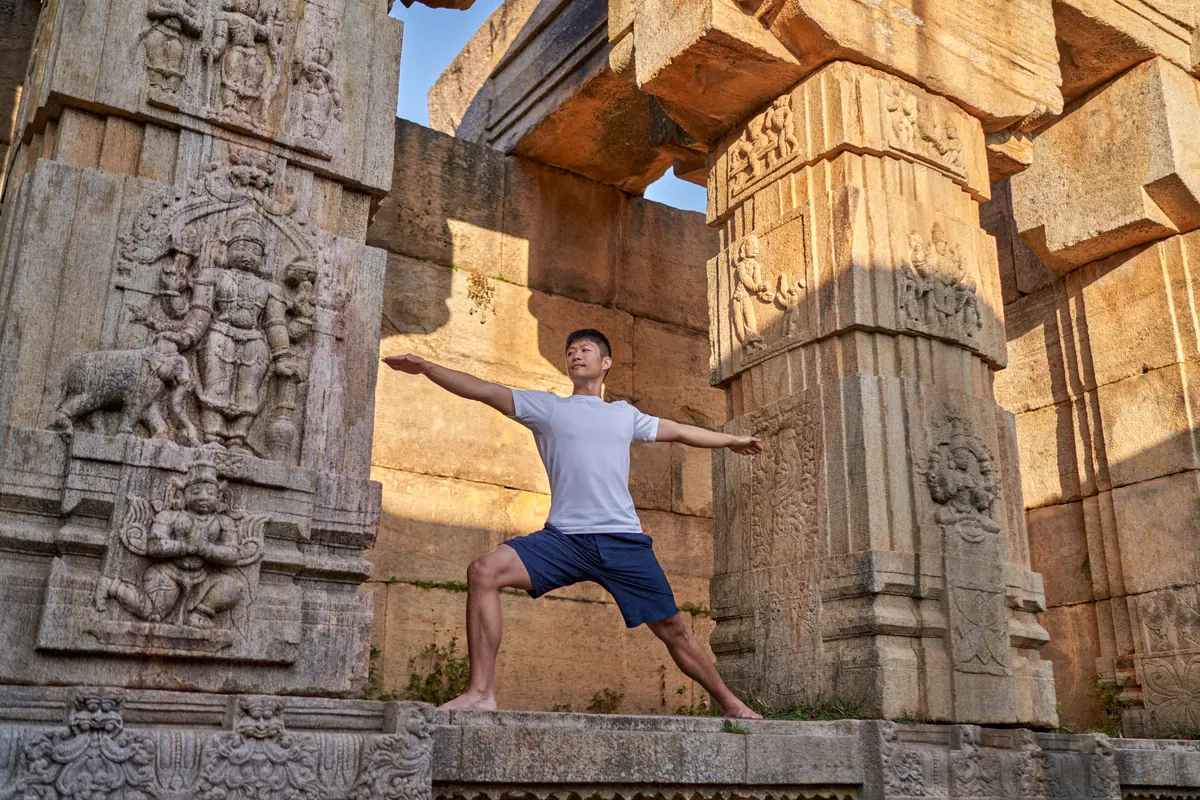
What Is Ashtanga Yoga? A Complete Guide
History & Lineage
Ashtanga yoga is a traditional, physically disciplined practice in which postures are linked to breath in a fixed sequence, practised in the same order every session. The word "Ashtanga" comes from Sanskrit — ashta (eight) and anga (limb) — referring to the eight-fold path described in Patanjali's Yoga Sutras, one of the foundational texts of yoga philosophy.
According to the Ashtanga tradition, the system derives from the Yoga Korunta, an ancient text that Krishnamacharya is said to have learned from his teacher Rama Mohan Brahmachari. The original manuscript has been lost, so the teaching survives through the living lineage rather than a written source.
The practice as it is known today was developed by T. Krishnamacharya and his student K. Pattabhi Jois in Mysore, India during the twentieth century. Pattabhi Jois taught the method at his institute (later known as KPJAYI) for over seven decades. The tradition was carried forward by his grandson, Paramaguru Sharath Jois, who taught at the Sharath Yoga Centre (SYC) in Mysore until his passing in 2024; the lineage continues there under his family. Tung first travelled to Mysore in 2018 to deepen his practice, and from 2022 returned annually to study with Sharathji at SYC, receiving SYC authorization — a recognition granted only to teachers who demonstrate sustained commitment to the traditional method. He continues to return to Mysore each year to practise in the tradition.
Sri Tirumalai Krishnamacharya
The Father of Modern Yoga (1888-1989)
Sri K. Pattabhi Jois
Founder of KPJAYI, Mysore (1915-2009)
R. Sharath Jois
Current Lineage Holder & Grandson of Pattabhi Jois
The Eight Limbs of Yoga
The "eight limbs" are a framework for living and practising that extends far beyond postures on a mat. The physical practice (asana) is one limb — the gateway through which many people first encounter the others.
Non-violence, truthfulness, non-stealing, right use of energy, non-attachment
Cleanliness, contentment, discipline (tapas), self-study, surrender
The sequences practised on the mat — the most visible part of Ashtanga
Formal breathing exercises, traditionally introduced after proficiency in asana
Turning attention inward, away from external distractions
Sustained, single-pointed focus on one object or point
Unbroken flow of awareness — concentration deepened into meditation
Complete union — the practitioner and the object of meditation become one
In daily Ashtanga practice, asana, pranayama, pratyahara, and dharana are all at work simultaneously. The breath is controlled (pranayama), the senses are drawn inward through drishti (pratyahara), and concentration is maintained throughout (dharana). Over time, many practitioners find that the discipline on the mat naturally extends into the other limbs — how they treat others, how they relate to themselves, and how they move through the world.
Traditional Practice Methods
Ashtanga Yoga is traditionally practiced in two distinct methods, each offering unique benefits and experiences.
Led Class
In a Led class, the teacher guides the room through the Primary Series (or another series) at a set pace, counting each vinyasa in Sanskrit. Everyone moves and breathes together. This format teaches correct vinyasa count, builds stamina, and gives students the experience of practising in unison — something distinctly different from practising solo. See Tung's group class options →
- Learn the correct vinyasa count and sequence order
- Build cardiovascular stamina and endurance
- Experience the energy of group practice
- Ideal for students who already know some postures
Mysore Style
Mysore style is the traditional method of Ashtanga practice, named after the city in India where it developed. Each student practises at their own pace — moving through whatever postures the teacher has assigned — while the teacher circulates, offering hands-on adjustments, guidance, and new postures when appropriate. It is self-paced but not self-taught: the teacher-student relationship is central to the method. Learn more about Tung's Mysore classes →
- Individual attention and hands-on adjustments
- Practise at your own breathing rhythm — no need to keep up
- Postures are added gradually, one at a time
- The most traditional way to learn Ashtanga — recommended for beginners
The Six Series of Ashtanga
Ashtanga yoga is organised into six progressive sequences. Each series builds on the one before it, and students advance at their own pace under a teacher's guidance — not by personal choice.
Primary Series — Yoga Chikitsa
"Yoga Therapy"
The foundation. Sun salutations, standing postures, seated forward bends, twists, backbends, and finishing inversions. Designed to realign the body, build strength and flexibility, and establish the breathing and concentration habits that underpin everything that follows. Most practitioners spend years here — and that is by design.
Intermediate Series — Nadi Shodhana
"Nerve Cleansing"
Deeper backbends, headstand variations, arm balances, and leg-behind-head postures. This series works on the nervous system and energy channels, building on the physical and mental stability developed in the Primary Series.
Advanced Series A–D — Sthira Bhaga
"Divine Stability"
Four increasingly demanding sequences that require exceptional strength, flexibility, and years of dedicated practice. Only a small number of practitioners worldwide work at this level. These series exist as a reminder that there is always further to go — the practice is never "finished."
One Posture at a Time
In the Ashtanga tradition, a student does not choose which postures to practise. The teacher observes the student's ability and assigns new postures one at a time. A student might work on the same set of postures for weeks or months before receiving the next one. This patient, incremental approach is central to the method — it teaches discipline, humility, and trust in the process.
Tristhana — Three Places of Attention
The heart of Ashtanga practice is tristhana — three places of attention that, when engaged together, turn a physical practice into a form of moving meditation.
Breathing & Bandha
(Ujjayi Pranayama + Energy Locks)
Ujjayi pranayama is the deep, steady, audible breath maintained throughout the practice. Combined with bandha — the engagement of mula bandha (pelvic floor) and uddiyana bandha (lower abdomen) — it generates internal heat, creates core stability, and focuses the mind. The sound of the breath also serves as real-time feedback: if it becomes ragged or shallow, that is a signal to ease back.
Drishti (Gaze)
Focused gazing points that enhance concentration and prevent the mind from wandering. Each posture has a specific drishti that helps develop single-pointed concentration and inner awareness.
Asana & Vinyasa
(Posture & Movement)
Each posture has a specific form, and each transition follows a precise breath count — this is vinyasa. Inhale to enter, exhale to fold deeper, inhale to lift. The linking of breath and movement creates a continuous flow that generates heat, warms the muscles, and allows the body to move safely into deeper stretches. Vinyasa is what gives Ashtanga its characteristic rhythm and intensity.
When All Three Come Together
When breathing, drishti, and vinyasa are all engaged at once, the practice shifts from physical exercise to something closer to meditation. The mind has no bandwidth to wander — it is fully occupied with breath, gaze, and movement. This is where the deeper benefits of Ashtanga emerge, and it is something that can only be experienced through sustained, regular practice.
Benefits of Ashtanga Yoga
The benefits of Ashtanga yoga are cumulative — they build with each practice and compound over months and years. Because the sequence is fixed, practitioners can observe subtle changes in their body and mind that would be invisible in a class that varies every session.
Physical Benefits
- Builds functional, full-body strength through bodyweight movements
- Increases flexibility gradually and safely over time
- Improves cardiovascular fitness through sustained, heat-building movement
- Develops balance, coordination, and body awareness
- Supports joint health through controlled range-of-motion work
Mental & Emotional Benefits
- Builds focus and discipline — the fixed sequence frees the mind from decision fatigue
- Reduces stress and anxiety through rhythmic breathing and movement
- Develops resilience — showing up daily to practise the same sequence is itself a practice in perseverance
- Deepens self-awareness — the repeated sequence becomes a mirror for noticing patterns
- Creates community — Mysore rooms around the world share a common language and practice
Is Ashtanga Yoga Right for You?
Ashtanga has a reputation for being intense — and it can be. But the traditional method is designed to meet every student exactly where they are. Here are some common misconceptions Tung hears regularly.
"I need to be flexible first"
Flexibility comes from practice, not the other way around. In a Mysore class, a complete beginner might spend the first few weeks on sun salutations alone — and that is perfectly fine. The practice is adapted to the student, not the student to the practice. Tung regularly works with students who arrive unable to touch their toes.
"Ashtanga is just a hard workout"
The physical challenge is real, but it is a means, not an end. The heat, the breath, the repetition — these create conditions for the mind to settle. Many long-term practitioners say the real practice begins when the body stops being the main event. The fixed sequence is intentional: when the body knows what to do next, the mind can go somewhere deeper.
"Ashtanga and Vinyasa are the same"
Modern vinyasa flow classes borrow the breath-movement linking from Ashtanga, but the similarity often ends there. Ashtanga follows a fixed sequence practised in the same order every session; vinyasa flow varies each time. Ashtanga uses specific breathing (ujjayi), gazing points (drishti), energy locks (bandha), and a set progression system. Both are valid practices — they simply serve different purposes.
Ashtanga for Beginners
The best way to start is to show up. No prior yoga experience is needed. Tung recommends beginning with Mysore-style practice — it is the most traditional starting point and allows for completely individual progression. Alternatively, the Ashtanga Yoga Basic group class at Tapas Yoga HK is designed specifically for newcomers.
Moon Day Tradition
In traditional Ashtanga practice, Moon Days are observed as rest days. This custom recognises the influence of lunar cycles on the body — the human body, like the earth, is composed of roughly 70% water and responds to gravitational shifts.
Why Rest on Moon Days?
Full Moon: The moon's gravitational pull is at its strongest, which can leave practitioners feeling unusually energetic — and more likely to push past safe limits.
New Moon: Energy tends to be more inward and subdued. Practitioners often feel quieter and more reflective — a natural time to rest.
The Moon Day tradition is a reminder that rest is not the opposite of practice — it is part of practice. Honouring natural rhythms and knowing when to step back are skills that carry over from the mat into daily life.
Honoring Natural Cycles
Rest, reflect, and restore on Full and New Moon days
Tung's Journey to Mysore
In 2018, Tung embarked on a life-changing journey to Mysore, India, the birthplace of Ashtanga Yoga. There, he completed his RYT 200 Hatha & Ashtanga Yoga Teacher Training, immersing himself in the authentic practice under the guidance of traditional teachers.
From 2022 to 2024, Tung made annual pilgrimages to practice at the Sharath Yoga Centre (SYC) with Paramaguru Sharath Jois. These intensive practice periods deepened his understanding of the tradition and strengthened his commitment to sharing authentic Ashtanga teachings. Tung continues to return to Mysore each year to practise in the tradition.
The experience of practicing in Mysore - waking before dawn, practicing in silence with practitioners from around the world, and receiving direct guidance from Sharath - has profoundly shaped Tung's approach to teaching and his dedication to preserving the integrity of this ancient practice.
Bringing Mysore to Hong Kong
Ready to Begin Your Ashtanga Journey?
Whether completely new to yoga or looking to deepen an existing practice, Tung welcomes anyone interested in traditional Ashtanga. There is no entrance requirement — just a willingness to show up and breathe.
Class Options Available:
Perfect for beginners
Traditional self-paced practice
Personalized guidance
Deep-dive experiences